

Cambodia Investment Review
Cambodia’s Royal Government has formally set its fiscal parameters for 2026, authorising the collection of more than 30.28 trillion riels (over $7.5 billion) in state revenue under the Law on Finance for Management 2026. The law, promulgated by Royal Decree on December 17, establishes the legal framework for budget execution in the coming year and signals the government’s intent to maintain fiscal discipline while supporting economic stability and long-term development.
According to the Ministry of Economy and Finance, revenue will be channelled into the national budget from fiscal, non-fiscal and other approved sources, in line with allocations to ministries and public institutions. The structure of the 2026 budget highlights the central role of taxation in Cambodia’s public finances, while also pointing to ongoing efforts to diversify revenue streams and strengthen resilience.
Key numbers at a glance
- Total projected revenue: more than 30.28 trillion riels (over $7.5 billion)
- Fiscal revenue: 25.34 trillion riels (over $6.3 billion)
- Non-fiscal revenue: 3.86 trillion riels (around $966 million)
- Other revenue sources: 1.08 trillion riels (about $270 million)
Taxes continue to dominate
Fiscal revenue is expected to account for the overwhelming majority of government income in 2026, underscoring Cambodia’s reliance on tax and customs collections as the backbone of its budget. This reflects steady improvements in tax administration and compliance over recent years, even as global and regional economic conditions remain uncertain.
Business leaders note that the General Department of Taxation has played a central role in driving reliable growth in collections, broadening the tax base and strengthening enforcement. At the same time, revenue from the General Department of Customs and Excise has faced headwinds, as free trade agreements reduce tariff revenue per eligible import. This dynamic has increased the relative importance of domestic taxation in sustaining public finances.
Anthony Galliano, Group CEO of Cambodian Investment Management Holdings and Vice-President of the American Chamber of Commerce in Cambodia, has observed that Cambodia’s revenue structure broadly mirrors those of other frontier and emerging markets, where governments depend heavily on taxes, social contributions and grants. However, he has also highlighted the need for further diversification to reduce pressure on tax authorities and create a more balanced revenue mix.

Room to diversify revenue
Economists say the 2026 budget underscores both progress and untapped potential. Property taxes remain low by regional standards, suggesting scope for broader application and stricter enforcement. Capital gains taxation has also been identified as an area where reform could generate additional revenue, particularly if existing cost deduction mechanisms are adjusted.
Beyond taxation, digitalisation remains a key lever. Wider adoption of tools such as e-invoicing and digital compliance systems is seen as critical to reducing leakage, improving transparency and expanding the formal economy. In parallel, improved performance and potential restructuring of state-owned enterprises, along with expanded public-private partnerships, could support both efficiency gains and revenue diversification over the medium term.
Economist Darin Duch has noted that the heavy weighting toward fiscal revenue in the 2026 budget points to a more rules-based and mature income system. Rising collections reflect expanding economic activity, improved compliance and the continued rollout of the Revenue Mobilisation Strategy. In his assessment, the size of the approved revenue envelope strengthens macroeconomic stability and provides greater fiscal space for strategic spending.
Managing pressures, maintaining balance
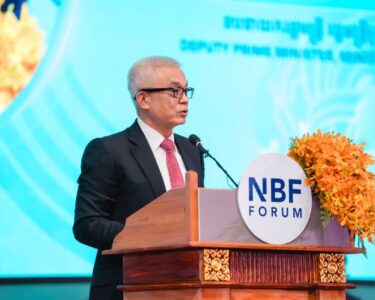
The Law on Finance for Management 2026 was drafted amid mounting fiscal pressures. Deputy Prime Minister and Minister of Economy and Finance Aun Pornmoniroth has indicated that the government continues to pursue its mandate of safeguarding national sovereignty and stability while accelerating socio-economic development toward upper-middle-income status.
Budget preparation has been influenced by a downward trend in certain revenue streams and rising expenditure needs, including national defence, pensions, social protection programmes, investment incentives and debt servicing. These pressures have been compounded by the drawdown of government savings following the prolonged impact of the COVID-19 pandemic and other external shocks.
Despite these constraints, the government has emphasised that the 2026 budget is balanced and sustainable, without drawing on remaining fiscal reserves. The spending framework aligns with the medium-term public finance plan for 2026–2028 and prioritises efficiency, governance reforms and human capital development.