
David Van
When people talk about competition between Cambodia and Thailand, the conversation often drifts toward familiar territory: border disputes, historical grievances, or comparisons of wealth. But that framing misses the deeper story. What is unfolding between these two neighbors is not simply a contest of size or power — it is a test of economic velocity, and it reveals a far more complex and telling dynamic than raw numbers ever could.
Most conventional economic comparisons rely on static indicators: GDP size, per capita income, export volume, or infrastructure scale. These figures matter, but they only tell part of the story. They describe what exists, not how it came to be or how fast it is changing. Judging economic strength solely by accumulated wealth is like judging a marathon by the final snapshot of runners without knowing who started when, or who has been sprinting uphill.
This is where the idea of economic velocity becomes critical. Velocity looks not at how much a country has, but at how quickly it is building — how rapidly it is transforming capacity, institutions, skills, and confidence. It asks not “who is richer,” but “who is moving faster relative to where they began.”
When viewed through this lens, the comparison between Thailand and Cambodia shifts dramatically.
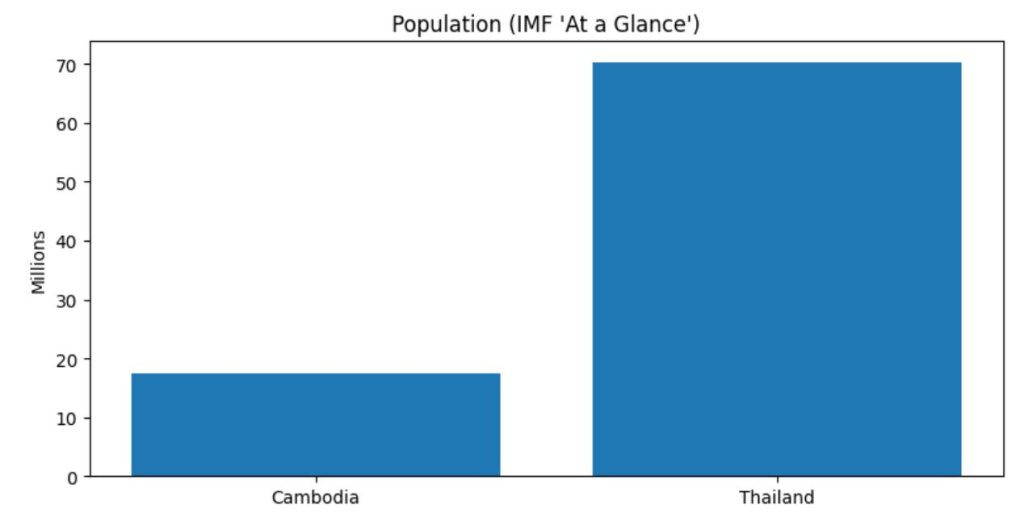
Thailand’s modern development trajectory stretches back roughly three centuries. It has benefited from long periods of political continuity, institutional consolidation, and uninterrupted capital formation. Over time, this allowed the country to accumulate infrastructure, human capital, industrial ecosystems, and regional influence. Even with recent political instability, Thailand still operates from a deeply entrenched economic base built over generations.
Cambodia’s timeline, by contrast, is radically different. Its effective modern starting point is not decades ago, but barely a quarter of a century. The devastation of the Khmer Rouge era wiped out not only lives, but institutions, education systems, professional classes, and economic memory. When peace and reconstruction began in the late 1990s, the country was not rebuilding from damage — it was rebuilding from near-zero.
Seen in that context, Cambodia’s progress over the past 25 years is not modest; it is extraordinary. Infrastructure has been rebuilt, cities have expanded, industries have formed, and a new generation of entrepreneurs and professionals has emerged. The country moved from survival to participation in global trade within a single generation — something that took others centuries.
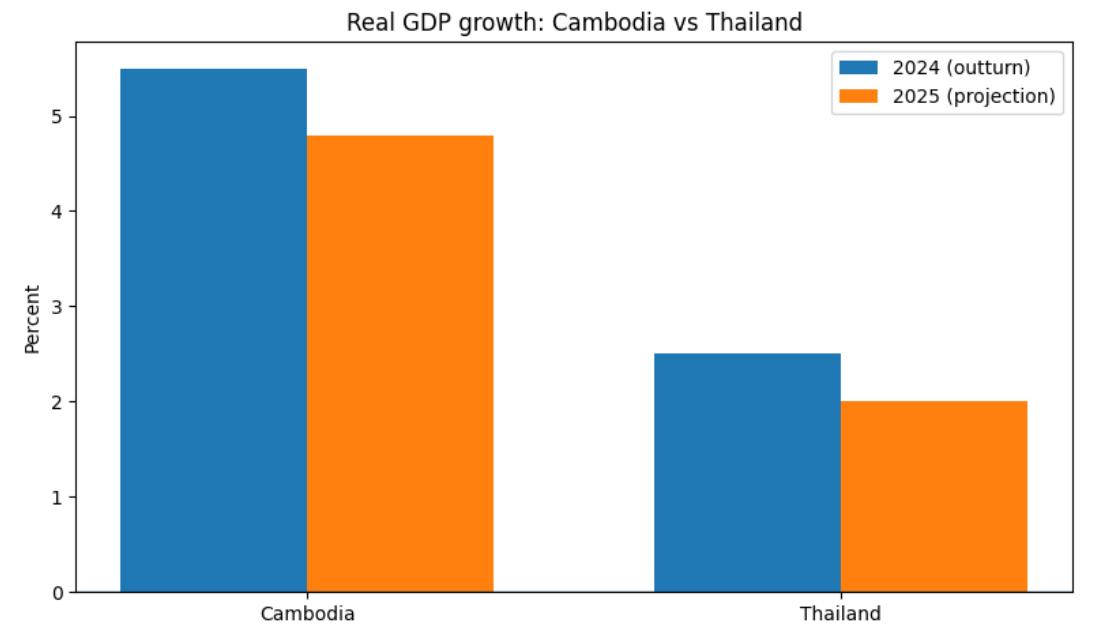
Yet comparisons persist. Thailand’s per capita income remains significantly higher, and on paper, the gap appears wide. But this framing ignores the crucial variable of time. A country that has had 300 years to accumulate wealth will almost always appear stronger than one that has had only 25. The more meaningful question is not “Who is richer now?” but “Who is closing the gap faster?”
And this is where the idea of economic velocity becomes politically and psychologically uncomfortable.
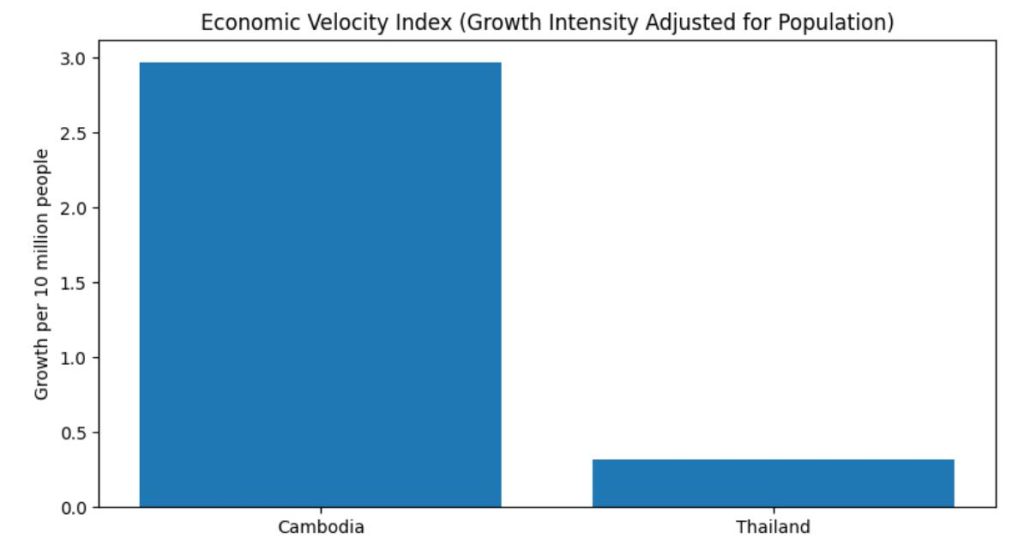
When a smaller, younger economy begins accelerating rapidly, it can trigger anxiety among those who have long occupied a dominant position. Growth ceases to feel abstract and starts to feel personal. Competition is no longer theoretical; it becomes visible in trade, labor mobility, investment flows, and regional influence. In such moments, friction often emerges — not necessarily because of hostility, but because momentum itself is destabilizing.
This angle suggests that some of the recent tensions between Cambodia and Thailand may stem less from historical disputes and more from this shifting economic dynamic. When the race begins to feel closer, the instinct may shift from competing harder to slowing the other runner down. Whether through regulatory barriers, political pressure, or narrative framing, the impulse to protect one’s relative position can surface in subtle but powerful ways.
Yet this is precisely the moment where Cambodia faces its most important test.
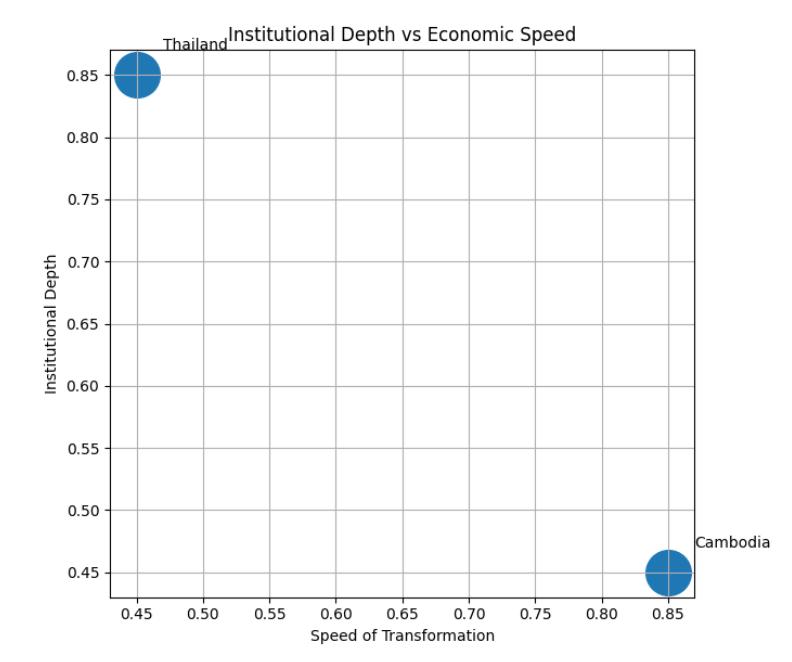
Rapid growth alone does not guarantee long-term success. Velocity without direction can lead to overheating, inequality, or structural weakness. For Cambodia, the next phase is not about proving it can grow fast — that part is already evident. The real challenge is whether it can convert speed into sustainability.
That means strengthening and thoroughly reforming domestic institutions state and private, deepening local value chains, and genuinely empowering Cambodian businesses rather than relying indefinitely on external capital or low-cost labor advantages. It means ensuring that growth translates into productivity, resilience, and opportunity across society — not just headline numbers.
It also requires confidence. A nation that understands its own trajectory does not need to measure itself anxiously against its neighbors. Instead, it focuses on building systems that can withstand pressure, competition, and change.
The question, then, is not whether Cambodia can “catch up” to Thailand in absolute terms. That framing misses the point entirely. The real question is whether Cambodia can stay true to its momentum — whether it can turn speed into structure, ambition into capability, and growth into lasting strength.
The narrative shifts entirely and the story is no longer about who started first or who is richer today. It becomes a story about transformation — and about how a nation once written off as broken learned to move faster, smarter, and with clearer purpose than anyone expected.
David VAN
28-12-2025
David VAN is a leading voice in Cambodia on economic transformation, public–private partnerships, strategic policy reform, impact investments and blended finance as well as TVET capacity building. He brings over four decades of experience advising government institutions, multinationals, and development institutions on building resilient, future-ready economies.