


By Harrison White
As Cambodia’s financial sector continues to deepen and diversify, the demand for strong governance, ethical leadership, and future-ready skills has become increasingly pronounced. In this edition of Leader Talks, Cambodia Investment Review sits down with Mr. Visal Sou, Chief Executive Officer of the Institute of Banking & Finance (IBF) Cambodia, to discuss his leadership journey, the evolution of IBF’s mandate, and how professional education is adapting to meet rising regulatory, digital, and governance expectations.
Drawing on extensive experience in education and leadership development, Mr. Sou shares how IBF has shifted from addressing immediate skills gaps to shaping the long-term governance and talent architecture that will underpin Cambodia’s next phase of economic growth.
Leadership Journey and Motivation
HW: You have a diverse background in education and leadership. What personal experiences and motivations ultimately led you to take on the role of CEO at the Institute of Banking & Finance, and how have these shaped the Institute’s direction?
My career has consistently been anchored in the belief that education is the indispensable foundation for national and industrial progress, and that people are at its core. From my early years in academic leadership to managing large-scale professional development programs, I have witnessed how structured learning transforms individual potential into industry-wide capability.
When the opportunity arose to lead IBF, I viewed it as both a privilege and a responsibility: to ensure that Cambodia’s rapid financial-sector growth is supported by a sustainable, ethical, and globally competitive workforce. This vision naturally extended beyond national borders, motivating me to actively engage with regional networks and to assume the role of Chairman of the Asian-Pacific Association of Banking Institutes (APABI). Through APABI, I have brought Cambodia’s perspectives into regional dialogues, fostered cross-border collaboration, and strengthened IBF’s capacity to deliver programs that meet international benchmarks.
These experiences have shaped IBF’s strategic direction through our IBPF (Individual, Business, People, and Future-Oriented) framework, which ensures that we address immediate technical needs while preparing professionals for future complexity. Leadership, integrity, and cross-border collaboration are treated as core competencies alongside technical proficiency, reflecting the belief that professional development in Cambodia must be both locally relevant and globally informed.
The Evolution of IBF’s Mandate
HW: IBF was established almost a decade ago to serve a growing need in the financial sector. Can you share the original vision behind the institute and how that mandate has evolved since its founding?
The original vision for IBF was to establish a rigorous foundation of professional competence within Cambodia’s banking and finance sector. Nearly a decade ago, the industry was expanding rapidly, and there was a clear need for structured talent development and standardized benchmarks for professional excellence.
Since then, our mandate has evolved significantly. IBF has moved beyond being a traditional training provider to becoming, in my view, a strategic talent architect. Today, our focus is on long-term transformation through leadership development, governance, innovation, and global competitiveness. We are no longer simply filling skills gaps; we are shaping the frameworks that will define the next decade of Cambodian finance and corporate governance. In simple terms, we have moved from teaching the alphabet of banking to helping professionals write the poetry of modern finance and governance.
International Standards and the Accredited Director Program
HW: How does IBF ensure its programs, including the Accredited Director Program (ADP), meet international benchmarks and remain relevant across different sectors?
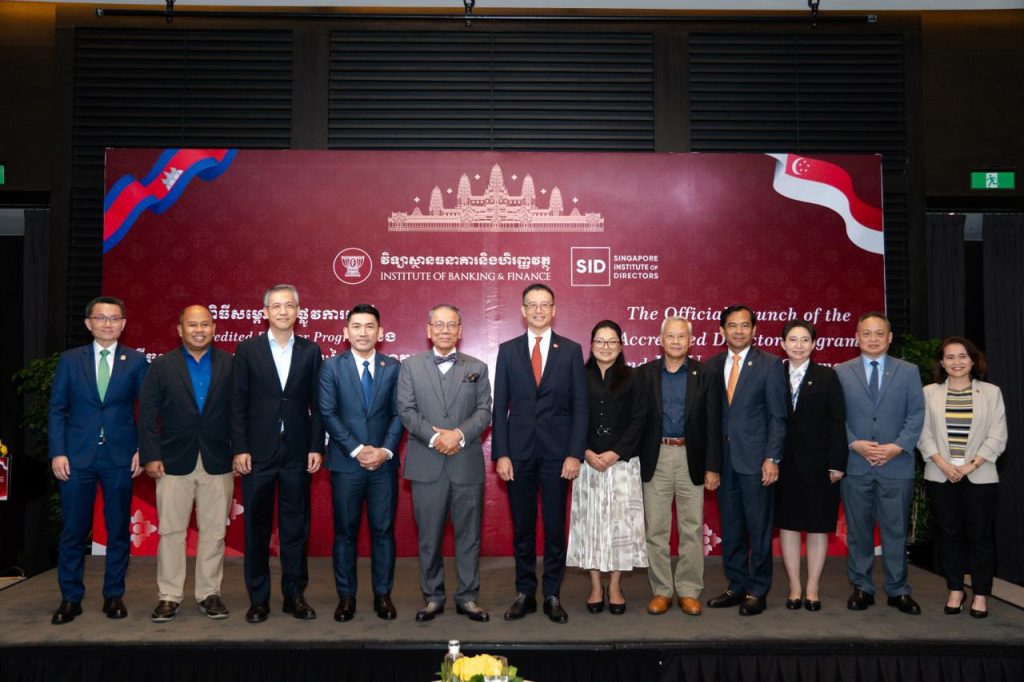
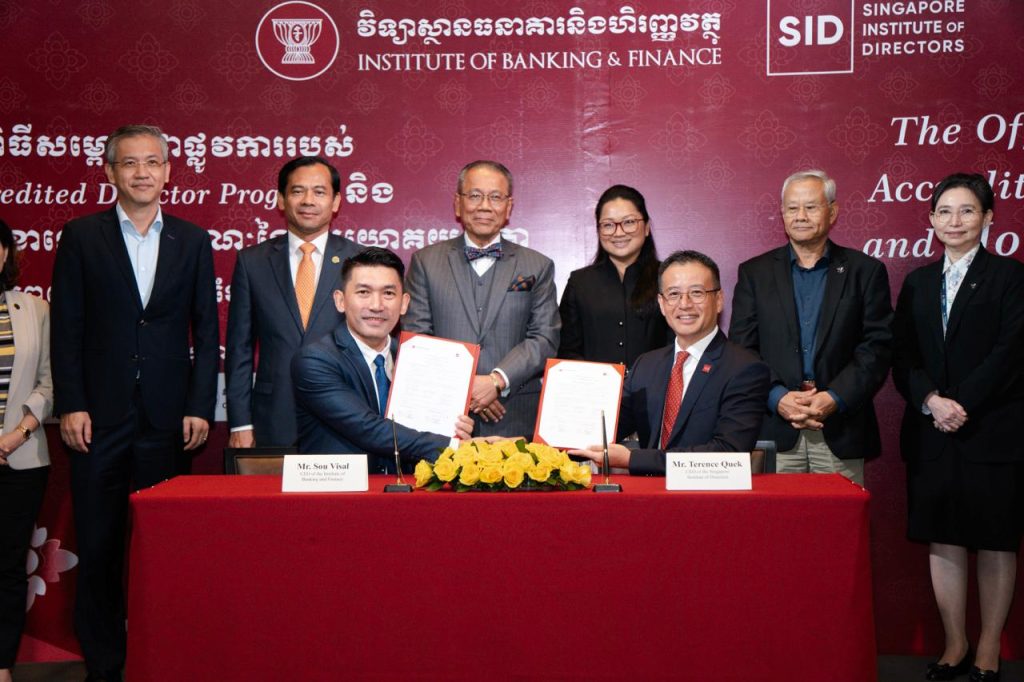
Professional standards are the backbone of national competitiveness, and IBF sees its role as setting benchmarks that elevate Cambodia’s corporate governance landscape. The Accredited Director Program, developed in collaboration with the Singapore Institute of Directors, reflects this commitment by aligning Cambodian board-level training with global fiduciary and accountability standards.
Relevance is maintained through continuous benchmarking against international frameworks, particularly in ESG, digital governance, and risk oversight. We emphasise applied learning through case studies and scenario-based simulations that reflect the real-world challenges boards and senior executives face in Cambodia. We also maintain close engagement with regulators and industry associations, ensuring that our programs remain aligned with evolving national and sectoral requirements.

Partnerships and Expansion Beyond Banking
HW: IBF is forming new partnerships every year. What are some of the most impactful recent linkages, and why is it important to expand beyond the banking sector?
Partnerships are central to IBF’s ability to deliver internationally relevant education and to extend our influence beyond Cambodia. Our collaboration with the Singapore Institute of Directors (SID) is a key milestone, as it allows us to embed global governance standards directly into Cambodian corporate practice. Equally important are partnerships with academic institutions such as the Institute for Banking Studies and Paragon International University, which help bridge the gap between academic learning and professional readiness.
At the regional level, my role as Chairman of the Asian-Pacific Association of Banking Institutes (APABI) has strengthened IBF’s ability to form cross-border collaborations. Through APABI, we connect with banking institutions across Asia-Pacific to co-develop training programs, exchange knowledge, and benchmark best practices. This network enriches our curriculum, enhances the quality of our programs, and ensures that Cambodian professionals benefit from global insights while contributing local perspectives to the regional dialogue.
Expanding beyond the banking sector is a strategic response to a broader national and regional need. Governance challenges are not confined to one industry, and operational and ethical risks increasingly cut across sectors. As Cambodia’s economy diversifies, IBF aims to extend the high standards developed in banking to sectors such as insurance, logistics, and SMEs, promoting stronger governance, accountability, and resilience across the wider corporate ecosystem. By leveraging both national and regional partnerships, including through APABI, IBF can raise standards across industries while maintaining global relevance.
The Future of Professional Education in Cambodia
HW: Short-course and professional education are changing rapidly. What do you see as the future for Cambodia in this space, and do you anticipate more mandatory training requirements from regulators?
Professional education in Cambodia is moving toward a more flexible and technology-enabled model, where blended and digital learning are becoming core delivery methods rather than supplementary tools. For professionals, this means learning that is practical, accessible, and integrated into their daily responsibilities.
At the same time, the content of learning is changing. Hybrid skills that combine finance, data literacy, and ethical governance are becoming essential. I also expect regulators to introduce more structured and mandatory training requirements in specialised areas such as risk management, compliance, and ESG. IBF’s role is to stay ahead of these developments, ensuring that Cambodian professionals are not only compliant but also positioned to compete effectively at a regional level.
Registration Now Open for the Accredited Director Program (ADP) – Batches 2 and 3 in 2026
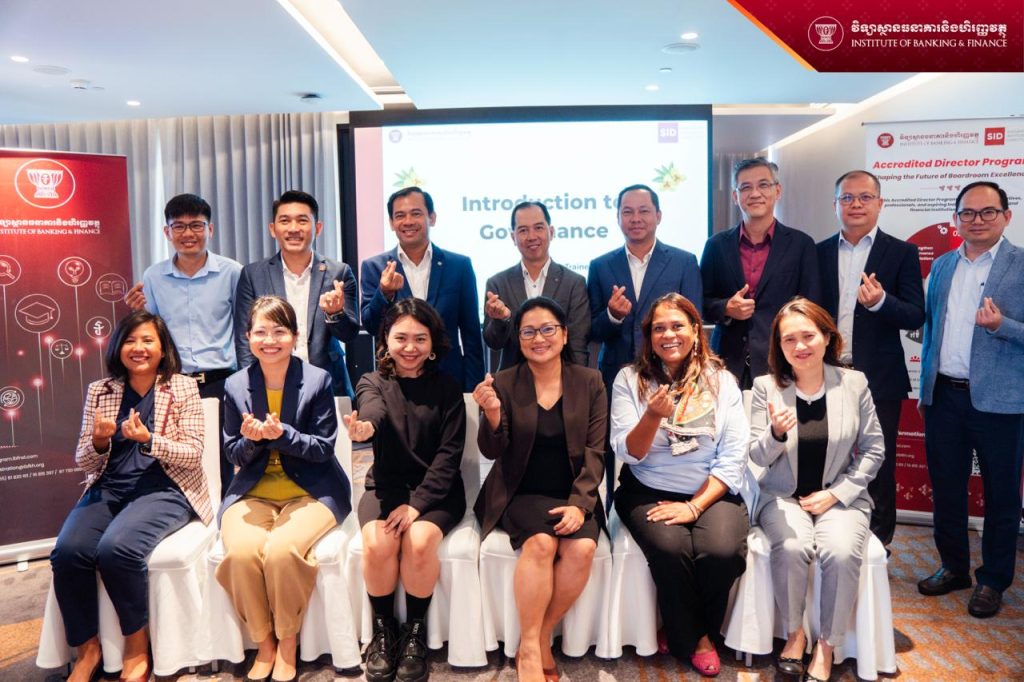
The Institute of Banking & Finance (IBF) is pleased to announce that enrollment for Batch 2 of the Accredited Director Program (ADP) is now open. This program is designed to equip corporate leaders with advanced governance knowledge and practical skills through a structured blend of e-learning and face-to-face training sessions.
For further information and to complete your registration, please contact:
Ms. Ouk Borey Chenda, Certification Manager
? ouk.boreychenda@ibf.com.kh
? Telegram: +85587730738