
By Lim Tai Toon – a Singaporean transformation and leadership specialist with global experience, currently based at Cambodia’s Manhattan SEZ.
In a multipolar world, Cambodia’s decisive advantage lies not in land or capital, but in cultivating a workforce ready to embrace lifelong learning and thrive alongside AI.
Cambodia stands at a critical juncture in its national development. Emerging from decades of turbulence, the country has entered a period of sustained growth. Foreign investment is flowing in, ASEAN’s economic integration is deepening, and Cambodia is increasingly visible on the global stage.
The challenge now is not simply to create jobs, but to ensure that those jobs evolve into meaningful careers for our youth—careers that match the global ambitions of our nation. The question is no longer whether Cambodia will grow, but how it will sustain that growth with dignity, innovation, and resilience.
In a world shifting toward multipolarity, every nation must identify its decisive advantage—its trump card. For Cambodia, that card is not land or capital, but the quality of its labour force. Amongst the traditional factors of production, it is quality labour that will define the country’s future competitiveness, especially as technology and geopolitics reshape the global order.
Labour Mobility in a New Generation
Cambodia’s workforce is overwhelmingly young: over 65% of the population is under 30. This demographic profile is striking compared to regional peers. Vietnam’s median age is 32, Thailand’s is 40, while Cambodia’s youth bulge is both a demographic dividend and a policy challenge.
Gen Z already represents more than a quarter of ASEAN’s workforce, and their mobility is unprecedented. They are digital natives shaped by smartphones, social media, and global cultural flows. Unlike their parents, they are less tied to traditional notions of loyalty to a single employer or industry. Their mobility is both geographic and sectoral: a Cambodian garment worker today may aspire to become a coder in Ho Chi Minh City tomorrow, or a hospitality manager in Bangkok next year.
This fluidity challenges employers who expect stability, but it also offers Cambodia a chance to position itself as a hub for regional talent circulation. If the government can create pathways for skills recognition, portable benefits, and cross‑border training, Cambodia could transform this mobility into a strategic advantage rather than a brain drain.
Tightening Labour Markets Ahead
Cambodia’s GDP is projected to grow 5.5–6% in 2025, driven by exports, tourism, and manufacturing. Foreign direct investment inflows surged to $8.1 billion between 2023–2024, a record high. This surge will inevitably tighten labour supply, especially in manufacturing and services, creating pressure on wages and skills.
At the same time, ASEAN’s expanding economy will siphon ambitious Cambodian workers toward higher‑wage workplaces in Singapore, Thailand, Vietnam, and Malaysia. Unless addressed, this competition will strain local businesses and widen the skills gap.
Comparisons are instructive. Vietnam has aggressively invested in vocational training and digital literacy, enabling it to attract high‑tech FDI in electronics and semiconductors. Thailand has focused on upgrading its tourism and healthcare sectors. Cambodia risks being left behind if it does not match these efforts with its own labour‑focused strategy.
Trust Deficit and Low‑Tech Disconnect
The garment sector employs over 918,000 workers, 75–80% of whom are women, with a minimum wage set at US$208 in 2025. Yet surveys show many workers struggle to cover basic expenses, with 40% taking secondary jobs due to low wages.
Older employers expect loyalty before rewards, while Gen Z demands upfront trust and fair compensation. This generational divide is compounded by Cambodia’s reliance on low‑tech, high‑labour industries such as garments and assembly, which exported US$13.6 billion in 2024. Many of these businesses are owned by older generations with outdated management styles, while the labour supply is dominated by Gen Z digital natives who value autonomy, fairness, and purpose.
The mismatch risks high turnover, declining productivity, and even social friction. Bridging this trust deficit and modernising workplace culture is essential if Cambodia is to sustain its economic base.
Climate and ESG Concerns of Young Labour
Globally, 70% of Gen Z workers prefer employers with strong sustainability commitments. Cambodia’s younger workforce increasingly expects ESG standards to be met. Yet many older business owners—especially in low‑tech industries—see ESG as a cost rather than an opportunity.
This divergence risks further alienating young workers. If companies fail to integrate sustainability into their operations, they will struggle to attract and retain talent. Conversely, firms that embrace ESG can position themselves as employers of choice, not only for Cambodian youth but for regional talent.
Cultural Nuances in Foreign Investment
In 2024, Chinese FDI accounted for roughly 75% of Cambodia’s total inflows. Investors from China, Taiwan, and Japan bring diverse management styles. Hierarchical structures, communication norms, and expectations of loyalty vary widely across these cultures.
Without preparation, Cambodian workers may feel misunderstood or undervalued, leading to friction. Government‑led cross‑cultural training will be essential to ease workplace tensions and maximize investment benefits.
AI as a Co‑Worker, Not a Tool
Most digital applications we use today—whether spreadsheets, messaging apps, or workflow platforms—are tools. They help us execute tasks faster, but they remain passive instruments. Artificial Intelligence, particularly Agentic AI (AGI), is fundamentally different. As Jensen Huang, CEO of NVIDIA, has argued: “Unlike current IT applications which are tools, Agentic AI is a co‑worker.”
This distinction matters. A tool waits for instructions; a co‑worker collaborates, anticipates, and even initiates. AI systems are increasingly capable of decision‑making support, creative contribution, and operational autonomy.
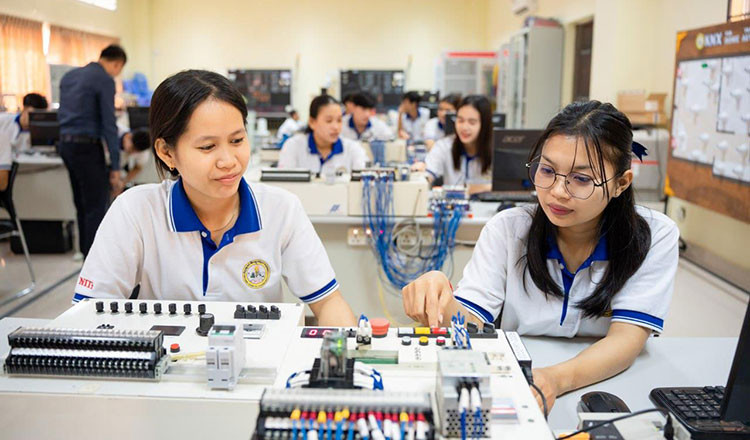
In Cambodia, recognising AI as a co‑worker means rethinking how we structure jobs and train workers. It is not enough to teach employees how to “use” AI like a software program. They must learn how to work with AI as a partner—delegating tasks, interpreting outputs, and integrating AI’s contributions into team dynamics.
Companies that treat AI as a co‑worker will see exponential gains; those that treat it merely as a tool will lag behind. For Cambodia, this is urgent. As foreign investors bring advanced technologies into the country, our workforce must be prepared not only to operate machines but to collaborate with intelligent systems.
Government Call‑to‑Action: Shaping Attitudes for Cambodia’s Labour Trump Card
To secure long‑term competitiveness, Cambodia’s government must go beyond building schools, training centres, and vocational programs. The real gap lies in shaping worker attitudes toward lifelong learning. National campaigns, incentives, and awareness programs should encourage workers to see training not as a burden but as an investment in their own future. In an AI‑enabled age, where technology evolves faster than institutions, self‑driven learning is the only guarantee of relevance.
At the same time, government policy must modernise industry while protecting workers. Regulations should ensure fair wages and transparent career pathways, but they must also reward companies that actively support continuous learning. Embedding ESG standards into national frameworks will align Cambodia’s industries with the values of younger workers, while incentives for digital adoption will help low‑tech sectors upgrade and remain competitive.
Finally, Cambodia’s government must strengthen national infrastructure and regional integration. Investment in broadband, cloud services, and digital platforms is essential to enable AI adoption and remote work opportunities. Labour standards should be harmonised with ASEAN to position Cambodia as a hub for regional mobility, while national cross‑cultural training initiatives can prepare Cambodian workers to thrive under diverse management styles brought by foreign investors.
Cambodia’s economic destiny will not be determined by capital or land, but by the quality of its labour force. In the age of AI and multipolar competition, human talent is the decisive factor. Quality labour is Cambodia’s trump card—the advantage that can carry the nation into a future of dignity, innovation, and prosperity.
Lim Tai Toon (TT) is a versatile professional manager whose extensive leadership experience spans the academic, public, for-profit, and non-profit sectors, with operational exposure across diverse markets including Singapore, Southeast Asia, China, Japan, Sri Lanka, and the UK. His strategic management approach, informed by his background as a military officer and his deep commitment to community transformation, specializes in complex areas such as corporate restructuring, M&A integration, and impact venture investments. TT, a Singaporean, is currently working in Cambodia’s Manhatten SEZ.
Note: This is the personal view of the author.
(CHINESE BELOW):
柬埔寨的王牌:在多极世界打出“特朗普牌”
作者:林大焌
导语: 在多极化的世界里,柬埔寨的真正王牌不是土地或资本,而是能在 AI 时代主动学习、不断提升的劳动力。
引言
柬埔寨正处在国家发展的关键十字路口。经历了数十年的动荡之后,国家进入了持续增长的阶段。外国投资不断涌入,东盟经济一体化加深,柬埔寨在全球舞台上的能见度也在提升。
如今的挑战不再是单纯创造就业岗位,而是确保这些岗位能够演变为有意义的职业——为年轻人提供与国家全球抱负相匹配的发展路径。问题已不再是“柬埔寨是否会增长”,而是“如何以尊严、创新和韧性来维持增长”。
在一个走向多极化的世界里,每个国家都必须找到自己的决定性优势——它的王牌。对柬埔寨而言,这张牌不是土地或资本,而是劳动力的质量。在传统的生产要素中,优质劳动力将决定未来的竞争力,尤其是在科技与地缘政治重塑全球格局的背景下。
新一代的劳动力流动性
柬埔寨的劳动力极为年轻:超过 65% 的人口年龄在 30 岁以下。这一人口结构在区域内十分突出。越南的中位年龄为 32 岁,泰国则为 40 岁。柬埔寨的“青年红利”既是机遇,也是政策挑战。
Z 世代已经占据东盟劳动力的四分之一以上,他们的流动性前所未有。他们是数字原住民,由智能手机、社交媒体和全球文化潮流塑造。与父母一代不同,他们不再受制于对单一雇主或行业的传统忠诚观念。他们的流动既是地理上的,也是行业上的:今天的柬埔寨服装工人,明天可能希望成为胡志明市的程序员,后年则可能成为曼谷的酒店经理。
这种流动性对雇主提出了挑战,但也为柬埔寨提供了机遇。如果政府能够建立技能认证、福利可携带性和跨境培训的制度,柬埔寨就能把这种流动性转化为战略优势,而不是人才流失。这样的措施不仅能留住本国人才,还能吸引区域内的青年劳动力,使柬埔寨成为东盟人才流动的磁石。
劳动力市场的紧缩
预计 2025 年柬埔寨 GDP 将增长 5.5–6%,主要由出口、旅游和制造业推动。2023–2024 年间,外国直接投资流入额达到 81 亿美元,创下历史新高。这股投资浪潮必然会收紧劳动力供给,尤其是在制造业和服务业,加剧工资和技能压力。
与此同时,东盟的扩张经济将吸引雄心勃勃的柬埔寨工人前往新加坡、泰国、越南和马来西亚等高薪现代化工作场所。如果不加以应对,这种竞争将使本地企业承压,并扩大技能缺口。
越南的经验值得借鉴:该国大力投资职业培训和数字素养,使其能够吸引电子和半导体等高科技外资。泰国则专注于升级旅游和医疗产业。若柬埔寨不能在劳动力战略上与之匹配,就有可能被甩在后面。
信任缺口与低技术产业的脱节
服装行业雇佣了超过 91.8 万名工人,其中 75–80% 为女性,2025 年最低工资定为 208 美元。然而调查显示,许多工人仍难以支付基本开支,40% 的人需要兼职第二份工作。
老一代雇主认为必须先证明忠诚才能获得回报,而 Z 世代则要求先获得信任和公平薪酬。这种代际分歧因柬埔寨依赖低技术、高劳动力产业而加剧——2024 年服装出口总额达 136 亿美元。许多企业由老一代管理者掌控,他们的管理方式与年轻数字原住民的价值观严重脱节。
这种错位可能导致高流动率、生产力下降甚至社会摩擦。弥合信任缺口并现代化工作文化,是维持经济基础的关键。
年轻劳动力的气候与 ESG 关切
全球范围内,70% 的 Z 世代工人更愿意选择具有强可持续承诺的雇主。柬埔寨的年轻劳动力越来越期望企业遵守 ESG 标准。然而许多老一代企业主——尤其是低技术行业——仍将 ESG 视为成本而非机遇。
这种价值观差异可能进一步疏远年轻工人。如果企业未能将可持续性融入运营,它们将难以吸引和留住人才。相反,拥抱 ESG 的企业可以成为首选雇主,不仅对柬埔寨青年,也对区域人才具有吸引力。
外资中的文化差异
2024 年,中国投资约占柬埔寨外资总额的 75%。来自中国、台湾、日本的投资者带来了多样化的管理风格。等级结构、沟通规范和忠诚期望差异巨大。
如果没有准备,柬埔寨工人可能感到被误解或低估,从而引发摩擦。政府主导的跨文化培训将是缓解职场紧张、最大化投资效益的关键。
AI:同事而非工具
我们今天使用的大多数数字应用——无论是电子表格、消息软件还是工作平台——都是工具。它们帮助我们更快完成任务,但始终是被动的。人工智能,尤其是“代理型 AI”,则完全不同。正如 NVIDIA CEO 黄仁勋所言:“与现有 IT 应用不同,代理型 AI 是同事。”
这一区别至关重要。工具等待指令,而同事会协作、预判甚至主动。AI 系统正越来越多地承担决策支持、创意贡献和自主运营。
在柬埔寨,认识到 AI 是同事意味着必须重新思考岗位结构和培训方式。员工不仅要学会“使用”AI,更要学会与 AI 合作——分配任务、解读输出,并将 AI 的贡献融入团队动态。
那些把 AI 当作同事的企业将获得指数级收益;而仅把它当作工具的企业将被甩在后面。对柬埔寨而言,这尤为紧迫。随着外国投资者将先进技术带入国内,我们的劳动力必须做好准备,不仅能操作机器,还能与智能系统协作。
政府的行动呼吁:塑造劳动力态度
为了确保长期竞争力,柬埔寨政府必须超越建设学校、培训中心和职业项目的层面。真正的缺口在于塑造工人对终身学习的态度。国家层面的宣传、激励和意识计划应鼓励工人把培训视为对未来的投资,而不是负担。在 AI 赋能的时代,技术发展快于制度,唯有自我驱动的学习才能保证持续的相关性。
与此同时,政府政策必须推动产业现代化并保护工人。法规应确保公平工资和透明的职业路径,同时奖励积极支持持续学习的企业。将 ESG 标准纳入国家框架,将使柬埔寨产业与年轻工人的价值观保持一致,而数字化激励措施则能帮助低技术行业升级并保持竞争力。
最后,政府必须加强国家基础设施和区域一体化。对宽带、云服务和数字平台的投资是推动 AI 应用和远程工作的关键。与东盟的劳动标准实现协调,将使柬埔寨成为区域劳动力流动的枢纽;而国家级跨文化培训计划则能帮助工人适应多样化的管理风格。
结论
柬埔寨的经济命运不会由资本或土地决定,而是由劳动力的质量决定。在 AI 与多极竞争的时代,人类人才是决定性因素。优质劳动力就是柬埔寨的王牌——这张“特朗普牌”将带领国家走向尊严、创新与繁荣的未来。
作者背景:林大焌(TT)是一位多元背景的职业经理人,其广泛的领导与学术背景经验涵盖公共部门、营利机构及非营利领域,业务范围遍及新加坡、东南亚、中国、日本、斯里兰卡和英国等多个市场。他曾担任军官,并深耕于社区转型,这一背景塑造了他的战略管理思维,擅长企业重组、并购整合与风险投资等复杂领域。TT为新加坡人,现任在柬埔寨Manhatten SEZ。
本文为作者个人观点